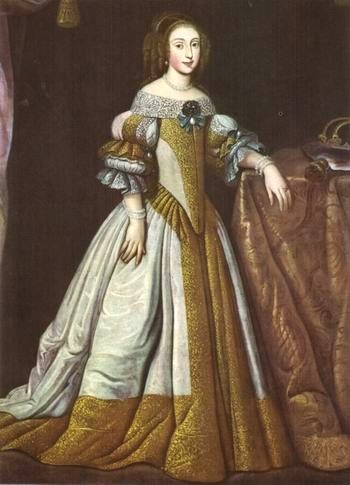
Born as a king’s daughter, but deprived of the title “princess”, Leonora Christina was married to a traitorous and somewhat stupid man (stupid in the sense of not to know when to stop scheming, kind of like Lady Jane Grey’s father?) who had her, though unintentionally, imprisoned for twenty-one years in rough conditions while he himself “enjoyed” the life as an exile abroad. The one good outcome of this was, however, the memoirs that Countess Leonora Christina left us of her conditions and the outside world.
Leonora Christine was born 8th of July 1621 as the third child to King Christian IV of Denmark-Norway and his wife Kirsten Munk whom he was married to morganatic (which is a type of marriage which can be contracted in certain countries, usually between people of unequal social rank, which prevents the passage of the husband's titles and privileges to the wife and any children born of the marriage). This meant that Leonora was not a princess, but she shared her mother’s title of Countess of Schleswig-Holstein. Nonetheless, she grew up with her parents in Copenhagen's royal palace on familiar terms with her three elder half-brothers — including the future King Frederick III. Nine years after she was born, she was betrothed to Corfitz Ulfeldt, son of a former Chancellor of Denmark. The same year her father divorced her mother, claiming that his wife had cheated on him, but Leonora seems to have retained her father’s favour still, and he took great interest that she and her sisters should not only learn traditional female pursuits as handicrafts, singing and dancing; they were also to learn how to read and to write, maths, play instruments, to draw and languages such as Danish, German and French, and also religion. Leonora Christina proved early to be a very quick learner, skilled in both academic and practical skills.
At the age of fiftheen, in 1636, she married her thirty year old husband, but despite the age difference Leonora seems to have been fond of him, and was a loyal and obedient wife to him, even refusing to speak ill of him after his death (which could have ensured her freedom). She had ten children by him.
Leonora and her husband travelled much, and Corfitz held lordships of Egeskov, Hirschholm Urup, Gradlitz and Hermanitz. In 1641 he was made a count by the Holy Roman Emperor Ferdinand III. During most of the 1640s her husband's power and stature grew and she was, in many ways, the first lady of the Danish court that had no queen.
When Leonora’s half brother Frederick ascended to the throne in 1648, her own and her husband’s position was threatened by the resentment of her husband's dominance by Frederick III and, especially, by his queen, Sophie Amalie of Brunswick-Lüneburg, who now became Leonora Christina's relentless enemy. Leonora Christina was active and outgoing, and easily outshined the queen.
Leonora Christina was stripped of her title as countess, and a woman named Dina Vinhofvers was engaged to testify that the couple Ulfeldt had planned to kill the new king.This false accusation was however revealed, and Dina Vinhofvers was executed.
For Leonora and her husband, this was a clear message that their time at the Danish court was now over. In 1651 they fled to Sweden, where Corfitz, thanks to his diplomatic experience and loans to the state coffers, got a position at court.
In 1657 Denmark declared war on Sweden. Ulfeldt become a trusted advisor to the Swedish King Karl X Gustav, which is naturally viewed as treason in Denmark.
After some time, problems arose between King Charles X Gustav and the Ulfeldts, and Corfitzen Ulfeldt was taken to court, accused of having collaborated with the Danes. This forced Leonora and her husband to flee back to Denmark, begging the king of mercy, but instead of granting it to them, he imprisoned them. The imprisonment lasted for a year and a half, eventually forcing the couple to take an oath of allegiance to the king.
Stupidly enough, Corfitz challenged the Danish king as soon as he was released and schemed to put the Elector of Brandenburg on the throne of Denmark-Norway, but Frederick III received information about this, and Corfitz was sentenced to death in absentia (as he was not in Denmark at that time, and thus was never able to return to the country without being killed).
Leonora was at the time in England to solicit repayment from King Charles II of money her husband had loaned him during his exile. The King repaid his debt by welcoming the Countess (his cousin) to his table, then having her arrested as she boarded a ship to leave England, whereupon he turned her over to Denmark in 1663.
For the next twenty-two years she remained in the custody of the Danish state, incarcerated without charge or trial in Copenhagen Castle's infamous Blue Tower. She lived under meagre and humiliating conditions for the daughter of a king, and was for years deprived of almost all comforts. During these years she perforce showed great ingenuity. She wrote that her cell was small, filthy, foul, infested with fleas, and that the rats were so numerous and hungry that they ate her night candle as it burned. She learned to piece together pages for writing from the wrappers on the sugar that she was given, and to make ink for her fowl's quill by capturing the candle's smoke on a spoon. Slowly she adjusted to her plight, ceased longing for revenge or death, and developed a mordant humour.
She only received less harsh treatment and more amenities following the death of Frederick III early in 1670. The new king, Christian V, sent his ministers to beget his mother's consent to free the prisoner. But, if Leonora Christina's account is to be believed, the Queen Dowager (her enemy) refused that she should be released.
Eventually the King had Leonora Christina moved to more spacious quarters in the tower, installed a stove against the cold of Copenhagen winters, and commanded that her window be opened. She was now allowed pen and paper, and it was at this time that she began to write in earnest, intending that her children might one day read her words.
Queen Dowager Sophie Amalie died in February 1685, and on the morning of 19th of May 1685 Leonora Christina was informed that she was to be released, and at 10 o'clock that night, Leonora left the Blue Tower forever under cover of darkness and a veil, denying even a glimpse of her face to the curious crowd that filled the courtyard (the Queen and her ladies watched from the palace balcony). For them Leonora Christina had already entered into legend — a royal adventuress who had been first regaled then held captive by the kings of England, Sweden and Denmark. She was sixty-three years old, and had spent twenty-one years, nine months and eleven days in the Tower. She lived her last years quietly on the grounds ofMaribo Monastery, where she occupied her time editing her prison notebooks. She died the 16th of March, 1698, seventy-seven years old.
During her imprisonment and for the twelve years she lived afterwards, she composed the book that made her famous, Jammersminde (A Memory of Lament), but it was not published before 1869. Today it is regarded as a classic of 17th century Danish literature, as it explores her prison years in detailed and vivid prose, recounting her crises, confrontations, humiliations, self-discipline, growing religious faith and serenity, together with fascinating descriptions of hardships she endured or overcame.
I know this was a very long text, but Leonora Christina was such a fascinating and strong, admirable woman and I could not cut this text any shorter.