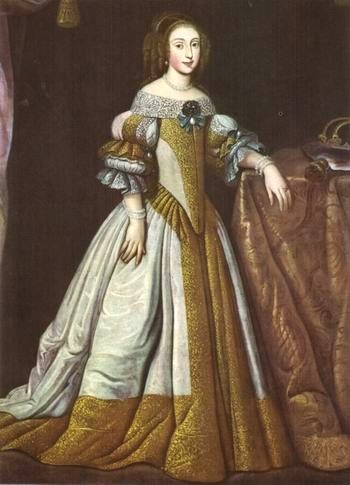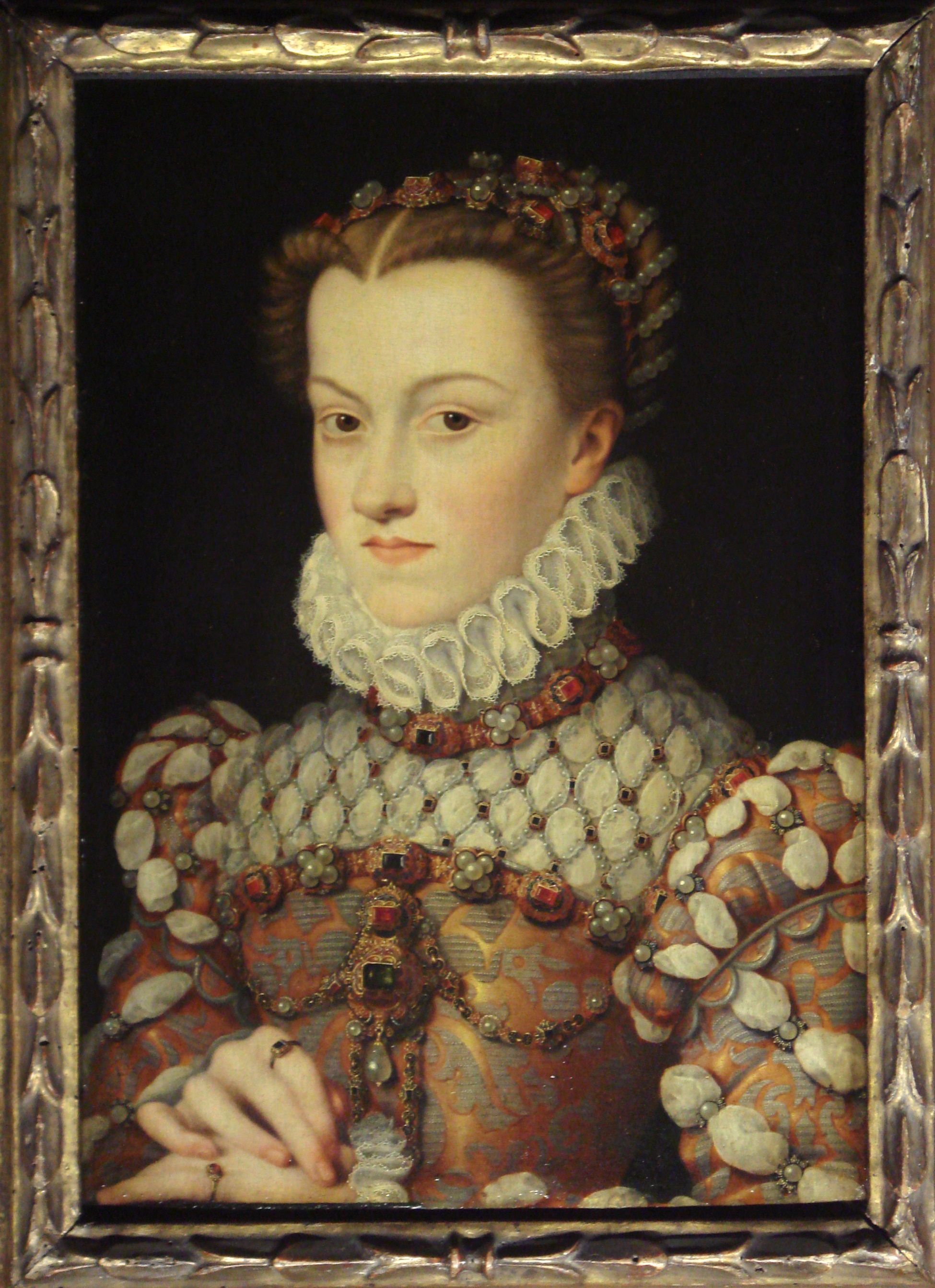
Elisabeth painted by François Clouet in 1571.
Considered as a great beauty and a very intellectual woman, Elisabeth was married off to Charles IX of France. As France was ruled by his mother, the infamous Catherine de Medici, Elisabeth was not involved in state of affairs, and was secluded from public life.
Elisabeth was the second daughter and the fifth child, born on the 5th of July in 1554 to the Holy Roman Emperor Maximilian II and his wife Maria of Spain. She became her father’s favourite as they were very alike, both in appearance and character. She was intelligent and lovely; her skin was white and smooth, her hair long and blonde, and her physique was perfect. Paired with her good looks was also her kind and pious personality, making her the perfect princess of her age. It is said that Elisabeth actually modelled herself after her namesake, Saint Elisabeth of Hungary.
Together with her older sister Anna and younger brother Matthias she lived secluded at Schloss Stallburg near Vienna. In 1562 the Maréchal de Vieilleville, a member of the French delegation sent to Vienna, exclaimed after see the eight-years-old princess: "Your Majesty, this is the Queen of France!" Elisabeth was married by proxy to Charles IX on the 22nd of October 1570. Catherine de Medici originally wanted her sister, Anna, as wife to the French king, but she was already promised to Philip II of Spain. Elisabeth left Austria on November 4, after long celebrations. Once in French territory, the roads were impassable thanks to the constant rain; this caused the decision that the official wedding was to be celebrated in the small border town of Mézières-en-Champagne. While staying in Sedan before reaching her destiny, the King, curious about his future wife, dressed himself as a soldier and went to Sedan to observe her incognito while she was walking in the palace of Sedan's garden with Henry, the Duke of Anjou. He was reportedly very happy about what he saw.
Together with her older sister Anna and younger brother Matthias she lived secluded at Schloss Stallburg near Vienna. In 1562 the Maréchal de Vieilleville, a member of the French delegation sent to Vienna, exclaimed after see the eight-years-old princess: "Your Majesty, this is the Queen of France!" Elisabeth was married by proxy to Charles IX on the 22nd of October 1570. Catherine de Medici originally wanted her sister, Anna, as wife to the French king, but she was already promised to Philip II of Spain. Elisabeth left Austria on November 4, after long celebrations. Once in French territory, the roads were impassable thanks to the constant rain; this caused the decision that the official wedding was to be celebrated in the small border town of Mézières-en-Champagne. While staying in Sedan before reaching her destiny, the King, curious about his future wife, dressed himself as a soldier and went to Sedan to observe her incognito while she was walking in the palace of Sedan's garden with Henry, the Duke of Anjou. He was reportedly very happy about what he saw.
Finally, Charles IX and Elisabeth were formally married on the 26th of November. The occasion was celebrated with immense pomp and extravagance, despite the French finances not being on top. The new Queen's wedding gown was of silver and her tiara was studded with pearls, emeralds, diamonds and rubies.
They never really fell in love with each other, but Elisabeth was delighted with her husband and did not hesitate to kiss him in front of others. However, Charles had a long-time mistress, Marie Touchet, and he soon returned to her. Still, the royal couple had a warm and supportive relationship. Charles realised that the liberal ways of the French Court might shock Elisabeth and, along with his mother, he made an effort to shield her from its excesses. Queen Elisabeth was fluent in German, Spanish, Latin and Italian, but she learned French with difficulty. She also felt lonely in the lively and dissolute French court, but she surprisingly befriended one of her controversial sister-in-law, Margaret of Valois.
As the pious and sober woman she was, she attended Mass twice a day, but despite her resentment of Protestants she was genuinely shocked and upset when she heard of the Saint Bartholomew’s Day Massacre where Protestants were slaughtered. Elisabeth never publicly rejoiced at so many deaths - like other prominent Catholics did. According to Brantôme, the next morning after the massacre, the shocked Queen asked her husband if he knew about it, when the King told her that he was the initiator, she said she would pray for him and the salvation of his soul.
At this time Queen Elisabeth was heavily pregnant, and she gave birth to her one and only child, a daughter, on the 27th of October 1572. She was named Marie Elisabeth after her grandmother, Empress Maria, and Elizabeth I of England who were her godmothers. Little Marie Elisabeth was deeply loved by her parents despite not being a future king to the nation. Charles, being sickly his entire life, died on the 30th of May 1574, leaving Elisabeth heartbroken and even more alone than she was.
After having completed the 40 days mourning period, Elisabeth, now called la reine blanche, the White Queen, rejecting her father's proposition that she attempt to marry her dead husband's brother - now King Henry III of France. As a widow, she was given the title Duchess of Berry. She left France for Vienna in December 1575, leaving her daughter behind. Three years later she also lost her daughter to an infection. The little princess was only six years old.
After the death of her daughter in 1578, she bought land upon which she founded a convent of the order of Saint Clare, were she spent the rest of her life, refusing all offers of marriage, including one from her uncle, King Philip II of Spain. She also wrote two books which are now lost.
Elisabeth died on the 22nd of January 1592 in Vienna, aged 37. By this time the House of Valois had been destroyed and a new royal family ruled France. She was buried in the church of the convent that she had founded. In 1782 her body was transferred to one of the crypts beneath St. Stephen's Cathedral, Vienna.
Source: http://en.wikipedia.org/wiki/Elisabeth_of_Austria,_Queen_of_France
PS! I must thank Amy over at Passages to the Past and author Christine Trent for the giveaway of A Royal Likeness which I was so lucky to win a copy of!
Source: http://en.wikipedia.org/wiki/Elisabeth_of_Austria,_Queen_of_France
PS! I must thank Amy over at Passages to the Past and author Christine Trent for the giveaway of A Royal Likeness which I was so lucky to win a copy of!